




Best Credit Cards for UPI Payments in India 2026
Most people scan QR codes every day without thinking about it. But if you are doing it with a debit card or a bank balance, you are getting nothing back on transactions you were going to make anyway.
There is one thing to know before comparing cards:
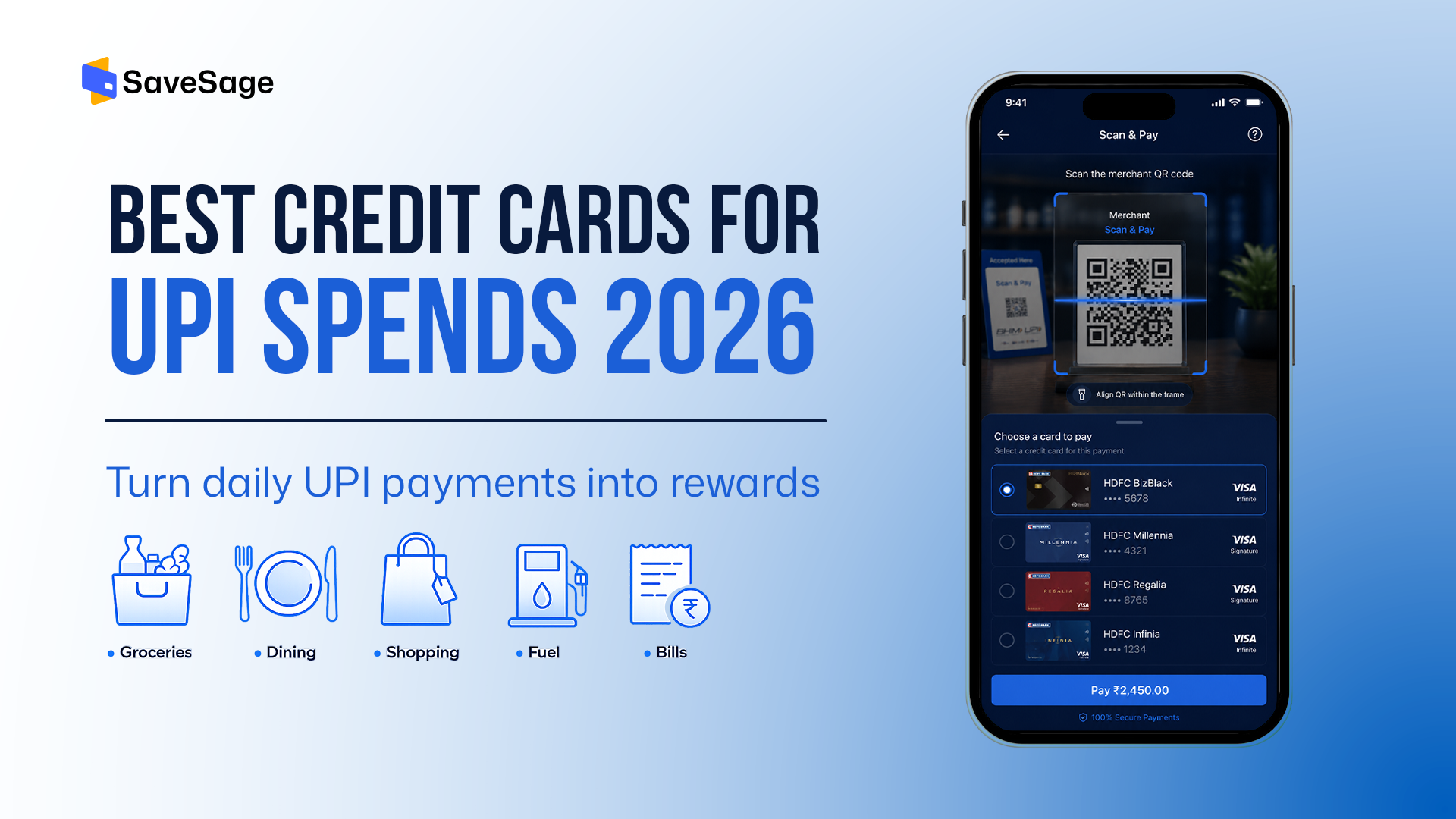
Only RuPay credit cards work on UPI QR payments in India. Regular Visa and Mastercard credit cards cannot be used in the same way for everyday merchant QR payments. So this comparison focuses on RuPay credit cards and UPI-linked routes that can earn cashback, reward points or travel benefits on eligible merchant payments.
The right UPI credit card depends on how much you spend through UPI, which payment app you use and whether you want cashback, points or travel-linked benefits.
Quick Answer: Which UPI Credit Card Should You Start With?
If you are just starting, Kiwi is the easiest UPI rewards card to begin with because it is built around everyday QR payments. From there, HSBC Cashback RuPay works better for smaller lifestyle spends, while HDFC Tata Neu Infinity makes more sense if you already use Tata Neu UPI regularly.
Axis SuperMoney and Axis Magnus RuPay are more conditional picks. SuperMoney works only if you understand its cashback caps, while Magnus RuPay is better treated as an add-on benefit for existing premium Axis users, not as a standalone UPI rewards card.
Best Credit Cards for UPI Payments in India
Reward rates, caps and eligible categories can change, so always check the latest card terms before applying or routing large spends.
Card / Route | Fees | Reward Value | Best For |
|---|---|---|---|
Yes / AU / PNB Kiwi | Varies by issuer; Neon costs ₹999 + GST | 0.5% – 5% | Everyday UPI QR rewards |
Federal Scapia RuPay | LTF | Around 1% + milestone benefits | UPI rewards with travel benefits |
Axis Magnus RuPay | ₹12,500 + GST | Premium EDGE Rewards; 35 EDGE RP per ₹200 applies only under Magnus accelerated-reward rules | Existing Magnus / premium Axis users |
HSBC Cashback RuPay | ₹499 | 1% – 10% cashback | Smaller daily UPI and lifestyle spends |
Axis SuperMoney | LTF | 1% normally; 3% through supermoney app with conditions | Users who understand revised cashback caps |
HDFC Tata Neu Infinity | ₹1,499 + GST | Up to 1.5% NeuCoins | Tata Neu app users |
PhonePe Gift Voucher Method | Depends on purchase route | Variable | Advanced optimisation route |
Most UPI credit card rewards apply only on eligible merchant payments. Personal transfers, wallet loads, rent, cash-like transactions and restricted categories may not earn rewards.
Yes / AU / PNB Kiwi
Best for: Users who want a simple starting point for everyday UPI QR rewards.
Kiwi works best when most of your spending already happens through UPI and you want a card that does not need much optimisation. Our Kiwi Credit Card review covers its rewards, fees and other benefits in detail.
The actual return can range from around 0.5% to 5%, depending on the issuer, membership type and transaction category. Higher rewards are usually linked to Kiwi Neon membership or issuer-specific reward rules, while regular spends may earn a lower return.
Recommended spends: Use it for everyday UPI payments until the monthly reward cap is reached.
Important points:
Neon membership costs ₹999 + GST.
Monthly rewards may be capped at 1% of the credit limit.
Yes Bank and AU may follow a one-card policy, so check issuer rules if you may want another card from either bank later.
PNB is also part of the Kiwi issuer list, but the same one-card-policy concern should not be assumed unless confirmed separately.
Federal Scapia RuPay
Best for: Users who want UPI rewards along with travel-linked milestone benefits.
Federal Scapia RuPay is not only about UPI rewards. Its value improves if you can also use the card for travel-linked milestones and airport-related benefits.
The base return may look modest, but users who can route around ₹20,000 of eligible monthly spends through the card may find the milestone benefits more useful.
Recommended spends: Around ₹20,000 per month, depending on the current milestone structure.
Important points:
Scapia advertises 5% rewards on eligible RuPay and UPI spends of ₹500 or more, but because 5 Scapia coins = ₹1, the practical travel value is around 1%.
Better suited for users who value travel benefits.
Not the strongest pick if you only want the highest direct cashback rate.
Read our Scapia Federal Bank Credit Card review for a detailed look at its rewards, lounge access and 0% forex benefits.
Axis Magnus RuPay
Best for: Existing Magnus users or premium Axis users who want to extend their rewards strategy to UPI spends.
Axis Magnus RuPay is not a card most people should get only for UPI payments. The fee is high and the card makes sense only if Magnus already fits your broader spending pattern.
On Magnus RuPay, UPI spends can earn the stronger 35 EDGE Reward Points per ₹200 rate only under Magnus accelerated-reward rules. Axis caps this 35 EDGE RP earn rate on UPI spends up to ₹50,000 per month, so it should be treated as a premium-user add-on rather than a simple UPI rewards card.
Recommended spends: Use only if Magnus already makes sense for you overall.
Important points:
The card has a ₹12,500 + GST fee, so UPI rewards alone should not be the reason to apply.
The UPI reward cap means it is not meant for unlimited UPI optimisation.
Do not apply only because of UPI rewards unless the rest of the card also works for you.
HSBC Cashback RuPay
Best for: Users who make frequent smaller UPI and lifestyle payments.
HSBC Cashback RuPay is useful for spends across food, grocery, dining, online orders and similar everyday categories. It can work well for people whose monthly spends are not very high but happen frequently.
Cashback is capped at ₹400 per month, so the card works best up to around ₹4,000 of spends in the 10% cashback categories.
Recommended spends: Around ₹4,000 per month in higher cashback categories.
Important points:
The card has a ₹499 fee.
No minimum transaction amount is required to earn rewards.
Better for smaller regular spends than for large monthly UPI spends.
Check eligible categories before assuming every UPI payment earns the highest rate.
Axis SuperMoney
Best for: Users who want a lifetime-free UPI card and are comfortable understanding cashback caps.
Axis SuperMoney is still useful for some users, but it is no longer a flat 3% UPI cashback card.
As of 1 January 2026, the reward structure works like this:
1% cashback on eligible UPI spends outside the supermoney app.
1% cashback on eligible non-UPI spends.
3% cashback on eligible UPI spends made through the supermoney app.
The supermoney app cashback is capped by the cashback earned from other eligible spends in the same statement month. Transactions below ₹100 do not earn cashback.
Recommended spends: Useful only if you have enough other eligible spends to unlock meaningful cashback on supermoney UPI spends.
Axis’s own example shows that if a user spends ₹11,000 through supermoney UPI and ₹30,000 on other eligible spends, the app-based cashback would be ₹330 before capping. The other eligible spends earn ₹300 cashback. Since the app-based cashback is capped at the cashback earned from other eligible spends, the supermoney cashback becomes ₹300, taking the total cashback to ₹600.
Important points:
Works best for users who understand the revised cashback structure.
The real value depends on how much other eligible spend you generate in the same statement month.
It is not a simple flat 3% cashback card anymore.
HDFC Tata Neu Infinity
Best for: Users who already use Tata Neu for shopping, bill payments or UPI.
HDFC Tata Neu Infinity can earn up to 1.5% NeuCoins on eligible UPI spends through Tata Neu UPI. This benefit is capped at 500 NeuCoins per month, which means the full 1.5% UPI benefit is useful up to around ₹33,333 of eligible UPI spends per month.
If you use other UPI apps instead of Tata Neu UPI, the return may be lower, usually around 0.5% on eligible UPI spends.
Recommended spends: Up to ₹33,333 per month on eligible Tata Neu UPI spends.
Important point:
The card has a ₹1,499 + GST fee, so it works best if you already use Tata Neu enough to justify the fee.
Bonus Option: PhonePe Gift Voucher Method
Best for: Advanced users who understand gift voucher routes and merchant acceptance limits.
This is not a normal RuPay credit card on UPI method. Instead, you buy PhonePe Gift Vouchers through a rewarding card or platform and then use those vouchers at eligible PhonePe merchant QR codes.
The effective return depends on how you buy the voucher. For example, if the card or platform used to buy the voucher gives 1%–2% cashback or rewards, that becomes the practical value of this route before considering merchant acceptance limits.
Recommended spends: Use only for specific merchants where you already know PhonePe Gift Vouchers are accepted.
Important points:
Acceptance may overlap with RuPay credit card QR acceptance, but it is not universal.
The best card for buying vouchers depends on the purchase route and merchant category.
Commonly discussed combinations include BOB Eterna, SBI Cashback, cashback cards and Axis Magnus through suitable purchase routes.
Which UPI Card Should You Choose?
If you want... | Consider... | Apply |
|---|---|---|
A simple starting option for everyday UPI QR rewards | Yes / AU / PNB Kiwi | |
UPI rewards with travel milestone benefits | Federal Scapia RuPay | |
Tata Neu app-based UPI rewards | HDFC Tata Neu Infinity | |
Premium UPI rewards as an add-on benefit | Axis Magnus RuPay | |
Lifetime-free card with revised cashback rules | Axis SuperMoney | |
Smaller UPI and lifestyle payments | HSBC Cashback RuPay | |
Advanced optimisation through PhonePe QR vouchers | PhonePe Gift Voucher Method |
Who Should Skip These UPI Cards?
You should not choose a UPI credit card only by looking at the highest reward rate.
Skip or be careful with these cards if:
you mostly use Google Pay, PhonePe or Paytm and do not want to switch apps;
most of your UPI spends are personal transfers, rent, wallet loads or restricted categories;
you want one simple card that works equally well across all payment apps;
you do not want to track monthly caps, app-specific rules or eligible categories.
Many UPI credit cards give their best value only inside a specific app. That is why the best card is the one that matches your actual payment behaviour.
Before choosing a UPI credit card, compare your actual monthly QR spends with the card’s eligible categories, app restrictions, reward caps and redemption value. SaveSage helps you check whether the rewards work for your real payment habits, not just the headline cashback or reward rate.
FAQs
Which credit card is best for UPI payments in India?
The best credit card for UPI payments depends on your spending pattern. Kiwi can work well for simple UPI rewards, HSBC Cashback RuPay is useful for frequent small payments, Axis SuperMoney can suit higher UPI spends and Tata Neu Infinity makes sense for users already active in the Tata ecosystem.
Can I use any credit card for UPI payments?
No. Regular Visa and Mastercard credit cards cannot be used for UPI QR payments in India. UPI credit card support is currently limited to RuPay credit cards, which can be linked to apps like PhonePe, Google Pay, and Paytm.
Do all UPI credit cards give rewards?
No. Rewards depend on the card issuer, payment app, transaction type, merchant category and monthly caps. Some cards may reward merchant QR payments, but personal transfers, rent, wallet loads and restricted categories usually do not earn rewards. Cards may also limit rewards after a specific monthly or statement-cycle amount.
Are UPI credit card rewards capped?
Yes, most UPI credit cards have reward caps. Some cap cashback, some cap reward points, and some require payments through a specific app to unlock the best return. That is why checking the cap is just as important as checking the reward rate.
Which UPI credit card has no annual fee?
Yes/AU Kiwi, Scapia Federal and Axis SuperMoney are all lifetime free with no annual fee. HSBC Cashback RuPay charges ₹499 per year. Axis Magnus RuPay and HDFC Tata Neu Infinity carry higher fees and are suited to users with premium spending profiles.